China’s Ambitious Move Towards Green Hydrogen: A Game Changer for Steelmaking
China is intensifying its focus on green hydrogen, a move that could revolutionize its steelmaking industry among other sectors. Faced with challenges of cost and logistics, China’s latest governmental policy seeks to boost hydrogen production, particularly “green” hydrogen generated from renewable energy, aiming to strengthen the nation’s vast industrial landscape.
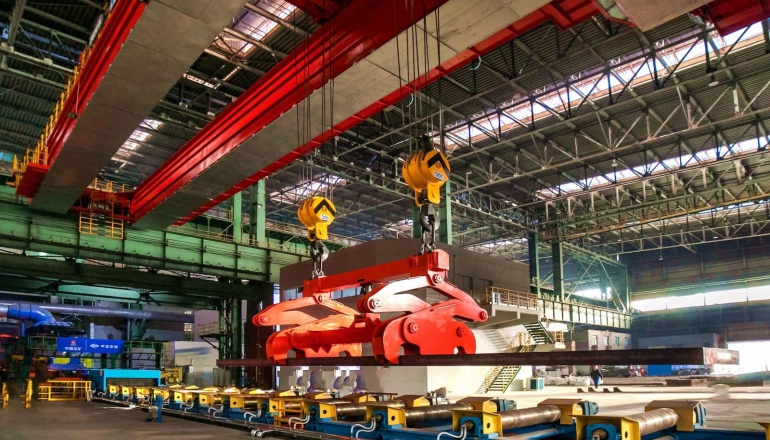
A steel panel rolls off a hydrogen-based production line at a Hebei Iron & Steel Group plant in Zhangjiakou, Hebei province. The facility is one of China’s first large-scale plants for hydrogen-based steelmaking, which has lower emissions than conventional coal-based blast furnaces (Image: HBIS Group / Xinhua / Alamy)
New Initiatives and Policy Framework
In March, the Chinese government announced a pilot program involving three ministries to incentivize hydrogen development. The program targets five city clusters that achieve set goals in the use of hydrogen, particularly focusing on the steel industry’s shift to low-carbon hydrogen sources.
According to a government report, hydrogen is of “great significance” for transitioning to clean energy. Similarly, the 15th Five Year Plan, China’s blueprint for economic progress from 2026-2030, emphasizes hydrogen as an “industry of the future.”
Hydrogen’s Growing Role in Industrial Decarbonisation
Since the launch of the first long-term hydrogen plan in 2022, hydrogen has gained strategic importance in China’s decarbonisation goals. The newly unveiled hydrogen policy, described as an “expanded 2.0” version of a 2021 program, continues to support hydrogen’s role in fuel-cell vehicles while expanding its industrial applications.

A hydrogen fuel-cell bus refuels at a station in Qingdao, Shandong province. Fuel-cell vehicles have been a focus of previous policies targeting China’s broader switch to electric vehicles (Image: CFOTO / Sipa USA / Alamy)
Transition Asia’s China head, Isadora Wang, expressed optimism, saying the program is a “very good initiative” for the steel sector, which she noted, has limited decarbonisation options compared to transport.
Challenges and Opportunities in Hydrogen Adoption
The new policy aims to reduce the end-use price of hydrogen from current levels of CNY 35-50 (~USD 5.10-7.30) per kilogram to CNY 25 by 2030, with some regions targeting even lower costs. However, this still falls short of the CNY 10-15 per kg needed for cost-effective hydrogen-based metallurgy.
Shen Xinyi, a steel analyst at the Centre for Research on Energy and Clean Air, noted that hydrogen’s broader application range complicates subsidy design. Unlike previous EV subsidies, the current program opts for “rewards rather than direct subsidies” to avoid past issues like fraud.
The Slow Rise of Hydrogen Steelmaking
China’s steel industry is in the early stages of adopting hydrogen, with only a few companies operating hydrogen-based facilities. State-owned giants like Baowu Steel and Hebei Iron & Steel (HBIS) are among the pioneers. Baowu recently completed a million-tonne hydrogen DRI-EAF line, while HBIS operates a similar plant in Hebei province.

Steel production at Huaigang Special Steel in Huai’an, Jiangsu province. Around 90% of China’s steel output still comes from coal-based blast furnaces (Image: CFOTO / Sipa USA / Alamy)
Despite these advancements, the move away from coal-powered blast furnaces is slow. The DRI-EAF method remains expensive, and stronger grid connections for green electricity are required.
Demand Dynamics for Green Steel
China, as the world’s largest steel producer, faces a significant overcapacity issue. Despite this, green steel has found markets, as shown by HBIS’s sale of hydrogen-produced steel to an Italian buyer. However, Wang from Transition Asia emphasizes the importance of China’s domestic market in consuming green steel.
Shen highlights the need for a “combination of cheaper green hydrogen, more reliable low-cost clean electricity, and stronger demand” to make hydrogen-based steelmaking commercially viable.
The future of hydrogen appears promising in China, thanks to its potential for low-cost production and robust supply chains across multiple sectors.
This article was originally published on Dialogue Earth under the Creative Commons BY NC ND licence. Read the original article.
Original Story at www.reccessary.com