Unseen Crisis: Climate Change’s Impact on Non-Communicable Diseases
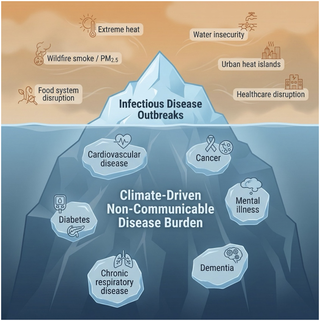
While the detrimental effects of climate change are commonly associated with rising sea levels and extreme weather events, a less visible but equally pressing issue is its impact on non-communicable diseases (NCDs). As environmental disruptions intensify, the syndemic relationship between climate change and NCDs grows increasingly concerning, yet remains underfunded and largely invisible.
Citation: Parameswaran G, Al-Kindi S, Rajagopalan S (2026) Climate change and non-communicable diseases: An invisible syndemic. PLoS Med 23(5): e1005082. https://doi.org/10.1371/journal.pmed.1005082
Published: May 8, 2026
Funding: The author(s) received no specific funding for this work.
Competing interests: The authors have declared that no competing interests exist.
Abbreviations: CVD, cardiovascular disease; ID, infectious disease; NCDs, non-communicable diseases
Human health is increasingly at risk due to the breach of multiple planetary boundaries, primarily caused by fossil fuel use. With over 3.6 billion people residing in climate-vulnerable regions, the situation is dire. In 2024, global temperatures exceeded the crucial 1.5°C mark above preindustrial levels, and current trajectories suggest a rise to 3°C by 2100. This warming trend significantly affects NCDs, including cardiovascular diseases and cancer, which currently account for 38 million deaths annually. These diseases are exacerbated by environmental stressors linked to planetary changes.
Climate change acts as a syndemic accelerator for NCDs, worsening existing health issues and creating complex interactions with social and environmental vulnerabilities. The indirect pathways through which climate change affects NCDs include disruptions to the hydrosphere and pedosphere, altering water availability and food quality, and increasing reliance on processed foods. These changes are projected to cause over 500,000 additional deaths annually by 2050, primarily related to cardiovascular diseases and cancer.
Planetary Disruption and Disease: An Integrated Framework
Climate change disrupts multiple planetary systems, causing a cascade of environmental stressors that affect human health at various scales. The direct impacts of atmospheric warming include increased heat-related mortality, which has surged by 63% since the 1990s, surpassing 546,000 deaths annually. Warming also degrades air quality, intensifying wildfires and dust storms, which in turn increase multi-organ NCD burden across cardiovascular, respiratory, and neurological systems. For instance, climate conditions are expected to lead to ~71,000 excess deaths annually due to wildfire smoke exposure between 2026 and 2055. The indirect effects of climate change include mental health deterioration due to the frequency of extreme weather events, which exacerbate mood disorders and trauma-related illnesses.
Climate Vulnerability: Disproportionate Burdens and Cumulative Disadvantage
Socioeconomically disadvantaged populations face the brunt of climate change impacts, highlighting an equity crisis. The Global South bears significant climate-related burdens due to geographic and infrastructural vulnerabilities, compounded by minimal historical emissions. In the U.S., formerly redlined neighborhoods are more susceptible to pollution and NCD risk due to dense impervious surfaces and limited green spaces. Occupational exposures further increase risk, with lower-income communities often engaged in manual labor jobs with high heat exposure.
Why We Fail to Act: Barriers to Prevention
Despite clear evidence of the link between climate change and NCD mortality, significant gaps in adaptation and mitigation strategies remain. NCDs, characterized by delayed pathways, obscure causations and create political stalemates. Partisan polarization exacerbates these issues, with climate denialism hindering intervention efforts. Economic barriers also play a role, as substantial upfront investments are needed for adaptation, which accrue benefits only gradually, discouraging long-term political commitment.
Towards a Multi-Level Adaptation Strategy
The urgent need for adaptation strategies spans communities, environmental infrastructure, and healthcare systems. Community interventions should focus on educating vulnerable populations and subsidizing adaptive technologies. Infrastructure improvements require interdisciplinary collaboration, involving healthcare professionals in urban planning to create climate-resilient environments. In healthcare settings, environmental risk assessments should be integral to patient counseling, particularly for vulnerable populations. Strengthening healthcare systems’ disaster preparedness through climate-resilient infrastructure is crucial to maintaining access during emergencies.
Original Story at journals.plos.org