Examining the Controversy Surrounding the Ivanpah Solar Power Facility
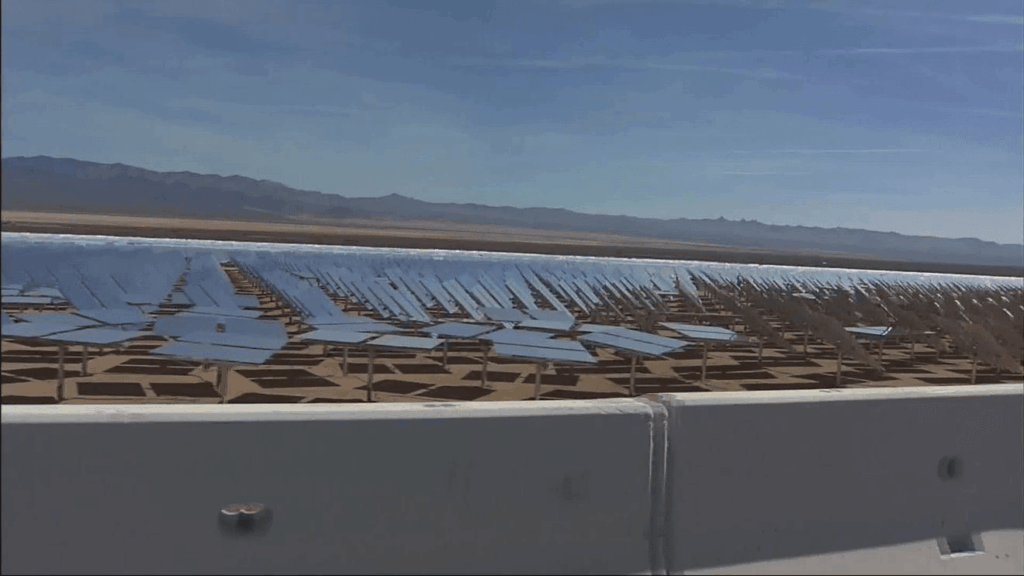
In the vast expanse of the Mojave Desert near Las Vegas, the Ivanpah Solar Power Facility stands as a colossal testament to the potential of solar energy. However, this $2.2 billion power plant has become a focal point of debate, raising questions about its efficiency, cost, and reliance on taxpayer funding.
Visible to those traveling along Interstate 15 near Primm, California, Ivanpah was heralded as the world’s largest solar thermal power station upon its opening in 2014. Yet, since then, it has been marred by controversies concerning its operating costs and overall performance.
Daniel Turner of Power the Future has voiced skepticism about the use of public funds for high-risk energy projects. Turner argues, “That’s the problem with Ivanpah, is that there is always a need for ingenuity and breakthrough technologies. But is it right for the government to use taxpayer money to subsidize risk? And this has been a risk. It has not worked and we’re never going to get our money back.”
During the Obama administration’s stimulus program, the project secured a $1.6 billion loan guarantee from the U.S. Department of Energy. Additionally, investors sought a $540 million federal grant to support the federal loan. Some estimates suggest that Ivanpah could increase energy costs for customers by $100 million annually.
Turner emphasized the plant’s reported efficiency levels, noting, “Reports have come out that they hit around 15 to 17% efficiency. And there’s no other investment that you can say, hey, it’s going to work only around a quarter of the time, or maybe a little bit less. Again, $2.2 billion for something that only works 17% of the time is a colossal failure.”
The facility operates with approximately 350,000 mirrors that focus sunlight onto a central point to generate electricity. Mark Jacobsen, a civil and environmental engineering professor at Stanford University, pointed out a significant drawback of Ivanpah’s design. “Its main disadvantage is it does not have storage. As a result, it has to use some gas to start up in the morning. Whereas if it had storage, it would not need any gas,” Jacobsen explained.
Jacobsen further compared Ivanpah to other solar technologies, noting that concentrated solar power plants are generally cost-effective. However, he remarked that Ivanpah appears outdated compared to photovoltaic solar technology, which is more versatile and often paired with batteries to store energy. “Photovoltaics are like panels that you could put on your roof. You can put in a you know over a large area of land as well lots of them. They take sunlight convert that sunlight into electricity. And they’re very convenient because you can put them up pretty much anywhere. They are coupled usually with batteries so that because the sun doesn’t shine at night,” Jacobsen stated.
Currently, Ivanpah sells its power to PG&E and Southern California Edison, yet both utilities are seeking to end their contracts, which are valid until 2039. The California Public Utilities Commission, however, has not granted approval to terminate these agreements, citing the significant investments already made and concerns over grid stability.
Jacobsen warned that decommissioning Ivanpah could ultimately incur higher costs, depending on its replacement. “Yes, if we replaced it with gas which is most likely because California has the third highest gas prices in the United States and in the it would just be used intermittently especially. And so that would mean the gas would actually be more expensive. So it’s actually cheaper to keep it running,” he mentioned.
Turner attributed the sustained demand for projects like Ivanpah to California’s stringent renewable energy standards, which he claims compel utilities to meet specific green energy quotas. “California has very, very strict green energy targets, and your governor brags about them. So if you’re the electric grid producer, if you’re a PG and E and you have to produce x percentage of your megawatt hours from a quote, unquote green source, or you get fined. You will. So they’ll they need Ivan Potter hit their green requirements,” he stated.
The ongoing debate over Ivanpah’s viability continues, as stakeholders assess whether the plant’s benefits justify its costs and if taxpayers and consumers will bear the financial burden of its continued operation.
Original Story at news3lv.com