Electric Vehicles: Rivian’s Approach to the Future of Fleet and Consumer Transportation
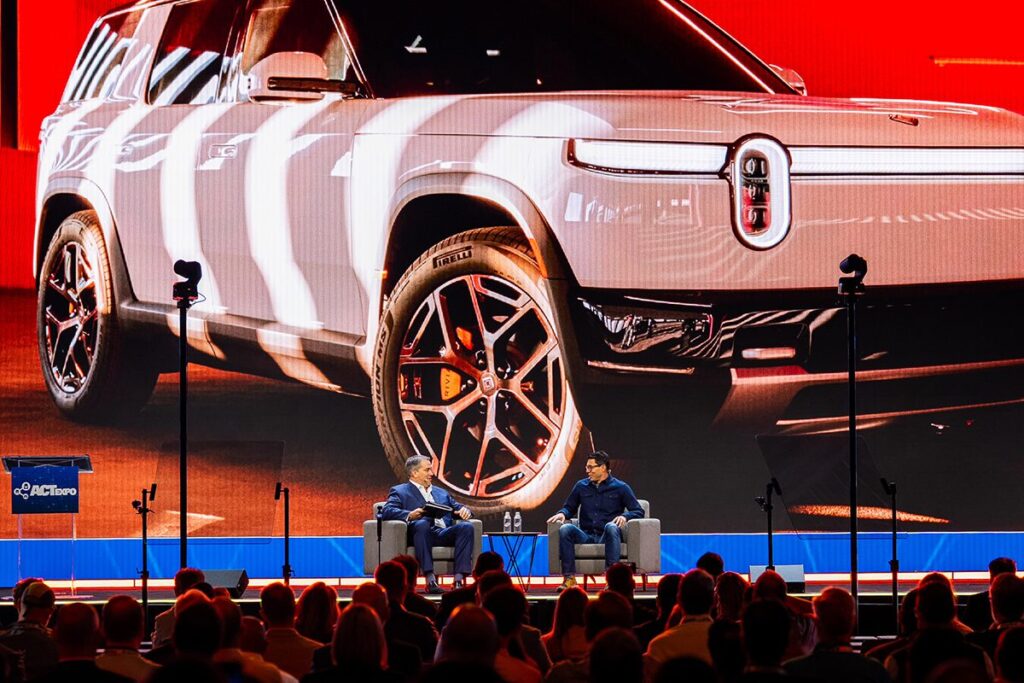
The shift toward electric vehicles (EVs) is no longer just a concept, as Rivian founder and CEO RJ Scaringe highlights the tangible benefits of EVs for commercial fleets, including cost savings and advanced connected fleet tools. Scaringe shared insights during a fireside chat at ACT Expo with Erik Neandross, president of TRC’s Clean Transportation Solutions team, emphasizing how EVs have begun to carve a practical niche in business operations.
Rivian, a company at the crossroads of electrification, software, and vehicle manufacturing, has already delivered thousands of EVs to commercial clients and is poised to expand its consumer and commercial offerings. Neandross expressed high anticipation for Rivian’s next phase, stating, “The level of excitement is high around EVs.”
Building a vehicle company from the ground up is complex, as Scaringe explained, highlighting the need for synchronized development in capital, engineering, and technology. Rivian, which launched its first products in 2021, including the R1T, R1S, and a commercial van, learned the importance of deliberate progress amidst pressure for rapid advancement.
One of Rivian’s strategic approaches has been its commitment to in-house development of vehicle technology, including computers, software platforms, and power electronics. This has resulted in a significant engineering organization geared towards achieving high production volumes. Scaringe aims for Rivian to produce millions of vehicles annually, starting with the mass-market R2 platform priced at $45,000.
Rivian’s collaboration with Volkswagen is a notable venture, involving a $5.8 billion deal to integrate Rivian’s electronics and software into Volkswagen’s EV fleet by 2027. “It’s enormously exciting to see the impact of what we’re building be driven not just into Rivian vehicles, but into large businesses like Volkswagen,” said Scaringe.
Scaringe also addressed the compelling case for commercial fleets, noting the early recognition of cost advantages and the potential of connected vehicles with integrated software for diagnostics and fleet management. This led to Rivian’s 2019 agreement with Amazon to deliver 100,000 electric vans, designed from scratch for last-mile delivery.
The Amazon fleet, with over 30,000 vans deployed, serves as a testament to the viability of EVs at scale. Scaringe remarked, “It’s a billboard, if you will, for the commercial space and for the fleet space.” The cost savings extend beyond fuel, with Rivian’s FleetOS supporting fleet services and integration with existing systems.
Rivian’s focus on software and AI-defined vehicles underscores the importance of a unified vehicle computing system, allowing for seamless updates and feature enhancements. Scaringe emphasized, “We issue, in the case of Rivian, about every month we have new features we add onto the vehicle.”
Autonomy is another significant focus, with Rivian’s 50,000-unit partnership with Uber marking a commitment to advancing autonomous technology. Scaringe anticipates major progress in autonomy between 2026 and 2031, driven by large neural networks and data from deployed vehicles.
Looking ahead, Scaringe foresees a transportation ecosystem transformed by AI, robotics, and new vehicle designs, including micro-mobility, drone delivery, and autonomous vehicles. He remarked, “We’re going to see changes that are maybe the most significant from a societal impact in the history of the developed world.”
Neandross concluded the discussion by emphasizing the immediate financial viability of commercial EVs, stating, “There are significant cost savings today, and it pencils out.” Rivian’s near-term commercial strategy aligns with a broader vision of electric vehicles that are connected, intelligent, and autonomous.
Original Story at www.act-news.com