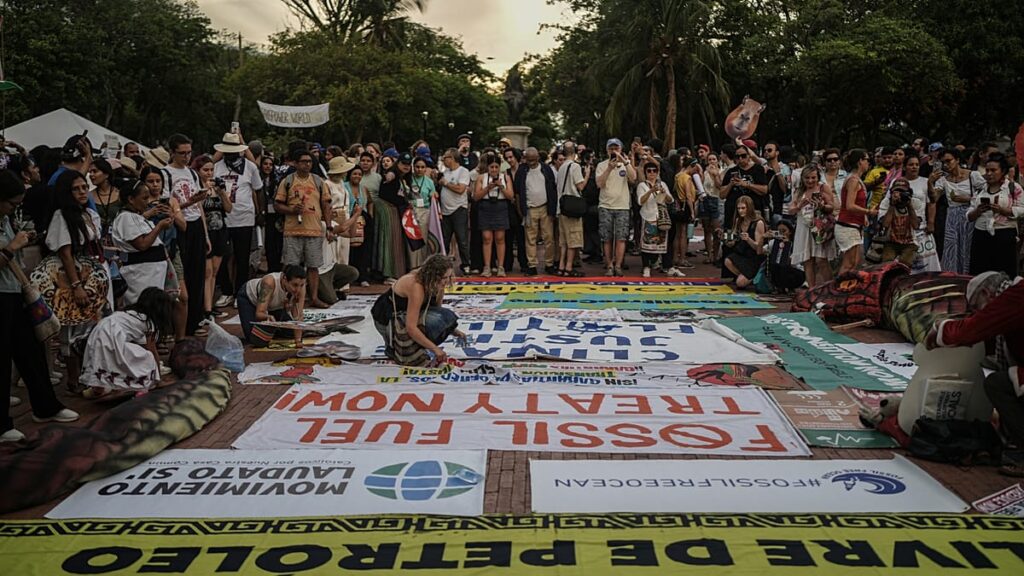
As climate concerns escalate, international efforts to address the crisis are increasingly scrutinized for their effectiveness. Despite global acknowledgment of the need to reduce reliance on fossil fuels, significant progress remains elusive. The annual UN-led climate gatherings, known as COPs, often conclude without substantial plans, leaving nations to navigate economic challenges independently. Read more here.
Recently, the Netherlands and Colombia have initiated a dialogue among world leaders outside the UN framework. “Right now, at the UN, we will not make big advancement on anything … because we are under the rule of consensus,” states Jean Lemire, Quebec’s climate envoy, highlighting the limitations of the consensus-based decision-making process.
This week, Colombia hosts the First International Conference on the Just Transition Away from Fossil Fuels, aiming to expedite the move from fossil fuels to sustainable energy sources.
Exclusion of the Trump Administration from Key Climate Talks
Despite representatives from 60 nations attending the conference in Santa Marta, the Trump administration was notably absent. Organizers focused on forming a “coalition of do-ers,” prioritizing governments eager to advance beyond fossil fuel dependency.
President Trump’s tenure has been marked by skepticism towards climate change and policies that bolster fossil fuel interests, such as exiting the Paris Agreement and diminishing the role of the Environmental Protection Agency. His actions have raised concerns about the impact on the environment and public health, as documented by various sources.
Colombian Environment Minister Irene Velez Torres responded to questions about the absence of major fossil fuel producers by stating that their presence often stifles discussion on transitioning from fossil fuels. She emphasized the importance of the more than 50 countries present, representing nearly half of the global population.
State-Level Climate Initiatives in the US
In contrast to federal policies, several US states are independently advancing climate action. California is leveraging carbon markets and low-carbon fuel standards to support the clean energy transition. “We remain steadfast in our commitment to carbon neutrality by 2045,” asserts Sarah Izant from the California Environmental Protection Agency.
Similarly, Quebec has enacted legislation to cease new fossil fuel exploration. Jean Lemire, Quebec’s climate envoy, underscores the challenges of aligning economic and energy policies with environmental goals while advocating for global collaboration in combating climate change.
Financial Barriers to Renewable Energy Adoption
Transitioning to renewable energy, while often more cost-efficient, is hindered by financial obstacles. Infrastructure investments and the replacement of oil and gas systems pose significant challenges. Moreover, developing nations face high borrowing costs, which can make clean energy projects less viable despite their long-term savings potential.
Amiera Sawas of the Fossil Fuel Non-Proliferation Treaty Initiative explains that while many governments are open to renewable energy, financial constraints limit their capacity to transition. In regions like Africa, borrowing costs for renewable projects can exceed those in wealthier economies, perpetuating reliance on fossil fuels.
Original Story at www.euronews.com