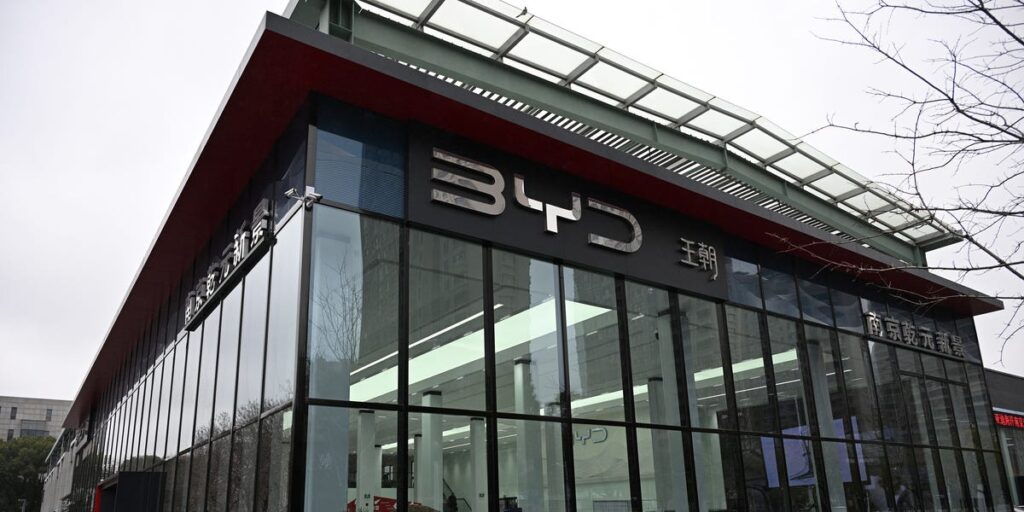
Challenges and Innovations: BYD’s Shifting Landscape in the EV Industry
Once celebrated as a global leader in electric vehicle production, BYD overtook Tesla in 2025 to become the world’s largest EV producer. However, recent developments have seen Tesla reclaiming the top spot, coinciding with a significant profit decline for BYD—the first since 2001. The Chinese auto giant has also seen a six-month streak of declining sales, with a notable 30% drop in the first quarter of 2026 compared to the previous year.
Despite these setbacks, BYD continues to expand its international presence, venturing into new markets like Canada and introducing advanced charging solutions capable of charging an EV battery from 10% to 70% in a mere five minutes.
The company’s declining performance can be attributed to several factors. The discontinuation of EV tax credits in the United States mirrors similar changes in China, where the expiration of purchase tax exemptions and reduced subsidies have impacted the market. Fierce competition from domestic brands such as Geely, Leapmotor, Nio, Xiaomi, and Li Auto has also intensified the challenge. Notably, Warren Buffett’s Berkshire Hathaway concluded its 17-year investment in BYD in September 2025, marking a significant shift in investor confidence.
In the United States, the Chinese automotive industry is viewed with both awe and apprehension. Speaking at the New York International Auto Show, John Bozzella, CEO of the Alliance for Automotive Innovation, emphasized the importance of fair competition, stating, “We support international competition, but only if it’s fair.” Concerns have been raised about the Chinese government’s subsidies to its automakers, which allegedly enable them to offer lower prices than their international counterparts. The Rhodium Group reports that while Chinese automakers are not necessarily more efficient, government support plays a crucial role in their cost competitiveness through grants, tax incentives, and preferential financing.
Sam Abuelsamid of Telemetry explains the competitive nature of the Chinese EV market, which hosts numerous brands, ranging from 129 to 300 according to various sources. The Chinese government is encouraging domestic automakers to move away from loss-leading pricing strategies, which has led to a slowdown in sales. “The Chinese EV market is highly competitive,” says Abuelsamid. “The government is putting pressure on Chinese OEMs to stop selling cars at a loss. They want to get away from a race to the bottom.”
BYD has managed to maintain some profitability, unlike many other brands that suffer from low production utilization. BYD achieved substantial sales figures in 2025, with 4.6 million New Energy Vehicles sold, evenly split between battery EVs and plug-in hybrids. This dwarfed Tesla’s 1.6 million vehicle output, predominantly comprising Model 3 and Y cars.
As BYD navigates these challenges, it remains a prominent player in the global automotive sector, but its future will depend on how it adapts to the evolving market dynamics and competition.
Original Story at www.autoweek.com