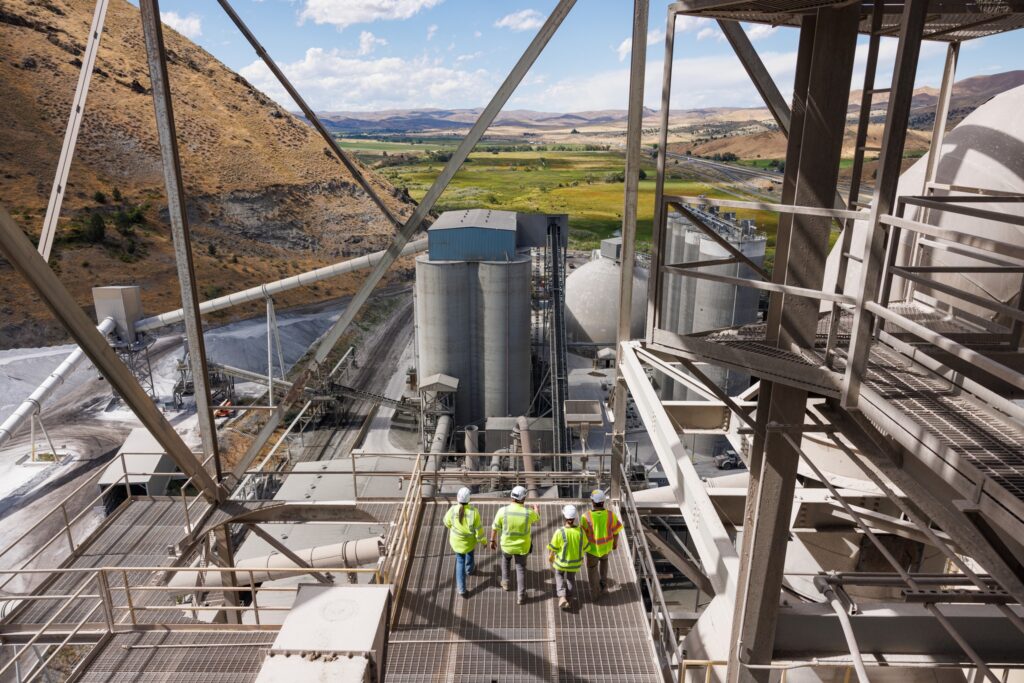
Since its inception in 1882, the Ash Grove Cement Company has grown significantly, now boasting 12 cement plants and 41 terminals throughout the U.S. and Canada. The company thrives with the dedication of over 2,200 employees. Ash Grove’s commitment to innovation is clear: “We stand together to reinvent the way our world is built,” the company states.
As a subsidiary of CRH, Ash Grove aligns with the American Cement Association in pursuing a Roadmap to Carbon Neutrality by 2050. This plan seeks to enhance energy efficiency across all stages, from production to the end use of cement in infrastructure, aiming to reduce carbon emissions per ton of product.
At Ash Grove’s Leamington, Utah plant, acquired in 1989, the company has implemented significant upgrades. Transitioning to Portland Type 1L Cement with higher raw limestone content, the plant now produces 962 tons of cement annually, serving areas like Salt Lake, Nevada, and New Mexico. The facility employs 104 people, supports 800 additional local jobs, and contributes over $798,000 in taxes yearly.
For more than a decade, Ash Grove has collaborated with Rocky Mountain Power’s Wattsmart Business program to enhance energy efficiency. Production Manager Josh Nelson noted the collaborative nature of the partnership, emphasizing project discussions and brainstorming sessions with Rocky Mountain.
Among the most impactful improvements is the upgrade of the finish mill, which reduced energy consumption by 3.3 million kilowatt-hours. Former plant manager Paul Pederson explained how a new fan installation minimized maintenance needs, resulting in $200,000 annual savings. Rocky Mountain contributed $500,000 in incentives, halving the $1 million project cost.
Another significant project involved converting facility lights to LEDs and other sustainable innovations, such as Continuous Emissions Monitoring Systems and alternative fuels usage. Ash Grove claims, “We have one of the highest fuel substitution rates in the industry,” significantly reducing coal reliance.
Through seven years leading up to 2024, Ash Grove cut its energy use by over 15 million kilowatt-hours—a reduction equivalent to powering 2,900 homes or charging 1.3 billion smartphones annually. Supported by $1.4 million in incentives from Rocky Mountain, the company reduced emissions by 10,772 metric tons, akin to recycling 3,700 tons of waste or removing 2,300 gas-powered cars from the road annually.
In an ongoing effort to boost energy efficiency, the Utah Inland Port Authority granted Ash Grove a property tax rebate to upgrade its kiln and add a second finish mill in Leamington. Ben Hart, UIPA’s executive director, remarked on the investment’s significance, emphasizing job creation and environmental benefits.
Other Ash Grove facilities also demonstrate leadership in efficiency. In 2024, its Seattle plant earned the U.S. EPA’s Energy Star Certification, followed by Branford, Florida. The Seattle plant optimized support equipment to conserve energy.
Colorado-based NovoHydrogen plans to establish a hydrogen production facility at Ash Grove’s Durkee, Oregon plant, hopeful to power vehicles and the plant itself by 2028. Meanwhile, Ash Grove’s Lincoln, Nebraska site began utilizing biomass instead of coal or natural gas in 2023, reducing emissions.
The company participates in sustainable initiatives like the U.S. Department of Energy’s Carbon Capture Demonstrations Projects Program, with a $15.2 million project planned for its Foreman, Arkansas facility. Ash Grove also manages waste through its Sapphire Americas subsidiary, converting non-recyclables into cement inputs or fuels.
Employees’ families benefit from the company’s success. The Ash Grove Scholarship offers $2,000 to employees’ children demonstrating academic achievement, and the Ash Grove Foundation funds local educational programs, such as a $25,000 donation to Branford High School in Louisiana.
Original Story at thebusinessdownload.com