
The global power industry witnessed significant changes in 2025, marked by unexpected developments and fluctuating trends.
Based on findings from Power Technology’s parent company, GlobalData, the year was characterized by contrasting shifts. Renewable energy sources surpassed coal in power generation, while gas became a renewed focus. The sector saw record transaction values despite fewer deals, and employment dynamics were influenced by geopolitical factors.
The industry is undergoing transformation in capacity, investment, and workforce dynamics.
Capacity and Generation: Changing Dynamics
Renewables on the Rise
In 2025, renewable energy became a dominant force, accounting for nearly half of the global capacity mix. Solar power led the way, contributing 64.1% of new capacity, with wind power adding another 16.4%. Together, they comprised 80% of new additions.
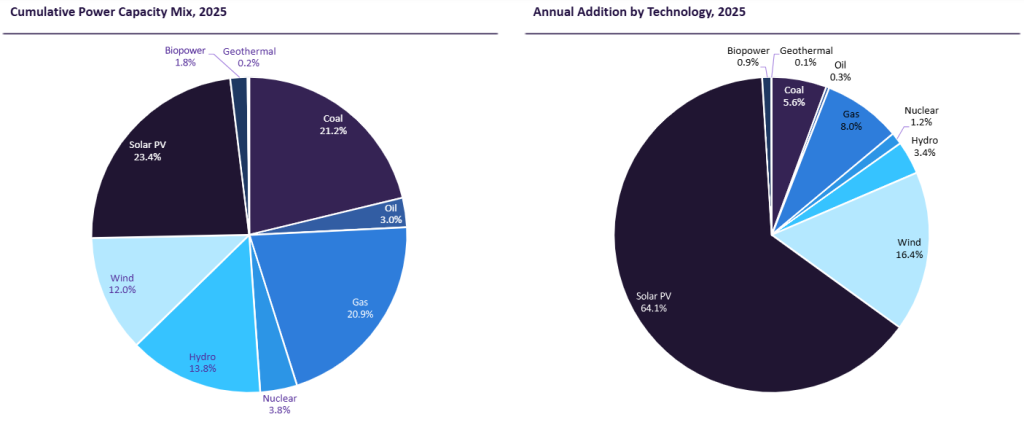
Source: GlobalData.
The surge in solar installations was driven by demand in regions such as China, the US, and India, supported by favorable policies and reduced costs. Harminder Singh of GlobalData attributes this growth to “supportive policy frameworks, climate-aligned national strategies, and distributed energy systems.”
China, a leader in solar PV production, accounted for a significant portion of global manufacturing capacity. India also emerged as a key player, with the help of the Production Linked Incentive Scheme.
Solar module prices continued to decline, enhancing project feasibility. Singh notes, “This, alongside improved grid access for solar PV as many countries invest in their transmission and distribution (T&D) networks, has made solar bankable for investors.”
Projections indicate global solar capacity will reach nearly 3TW by the end of 2025 and could exceed 8TW in a decade. Wind power is anticipated to reach about 1.3TW, predominantly from onshore installations.
The offshore wind sector faced challenges due to policy and tariff issues in the US, leading to funding withdrawals and project delays. However, Singh emphasizes that the long-term outlook remains positive, with a robust project pipeline.
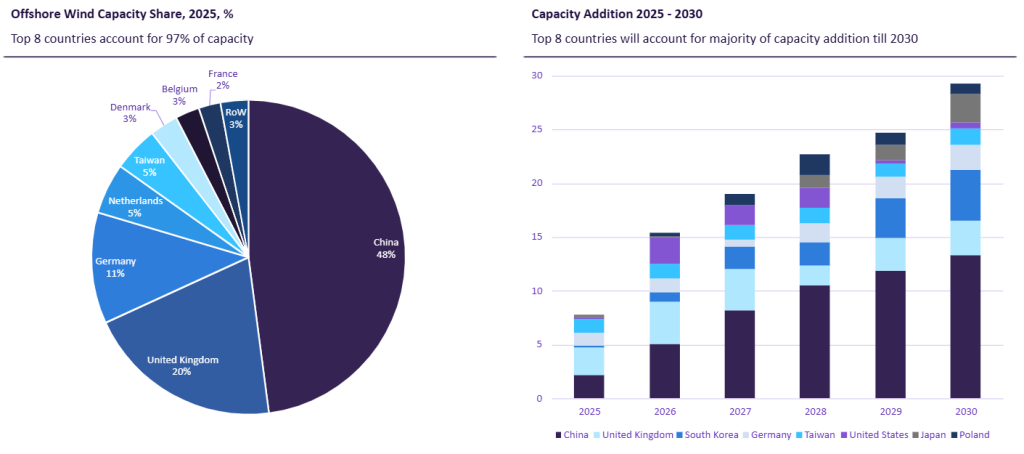
Offshore wind capacity share by country in 2025 and projected capacity additions (GW) between 2025 and 2030 of top eight countries by 2030. Source: GlobalData.
Renewables surpassed coal in power generation for the first time, with solar, wind, and hydropower contributing 34% compared to coal’s 31% share.
Pavan Vyakaranam, senior power analyst at GlobalData, remarked, “Despite tariffs, supply chain tensions and geopolitical headwinds in 2025, renewables kept expanding because their underlying economics and policy support are now deeply entrenched.”
Thermal Power’s Decline
Despite progress, coal remains a significant energy source, with thermal power demand declining slowly. Gas has often replaced coal rather than renewables in many markets.
Projections suggest 2033 as the turning point when renewables surpass all thermal generation. However, Singh notes, “coal will remain the single largest source of electricity.”
Gas power continues to play a role, particularly in meeting data center energy needs due to its quick construction timeline. The US, in particular, relies on natural gas for a significant portion of its power generation.
Thermal power, though losing ground, remains relevant, especially gas power, which acts as a stabilizer until alternatives like energy storage and grid modernization catch up.
Nuclear Energy’s Steady Progress
Nuclear energy’s share in the global capacity mix was small in 2025, but its potential is growing. GlobalData forecasts nuclear investments will reach $41.8bn by 2030, with small modular reactors (SMRs) gaining attention.
SMRs, along with emerging reactor designs, are expected to play a significant role in the future energy landscape.
Challenges for Hydrogen
Hydrogen faced hurdles in 2025, with project delays and policy uncertainties affecting capacity forecasts. Cumulative 2030 capacity projections dropped by 10% year-on-year.

The future of hydrogen as an emission reduction technology remains uncertain, with questions about its viability before 2040.
Deals: North America’s Dominance
Global power industry deals decreased by 16% in 2025 compared to 2024, but total deal value increased by 15%.
Mergers and acquisitions (M&A) led the charge, with acquisitions rising 23.96% year-on-year and mergers increasing by 123.43%. North America led with 1,659 deals valued at $780.5bn.
The US recorded $689.43bn in power sector deals, followed by India, China, and other nations. Asia-Pacific had more deals than North America but at a lower total value.
Solar PV transactions topped with 1,412 deals, while T&D investments attracted the most capital, reflecting the focus on grid infrastructure improvements.
Jobs: A Year of Volatility
Employment in the power sector experienced significant fluctuations in 2025. Hiring surged in Q1 but declined in subsequent quarters due to various factors.
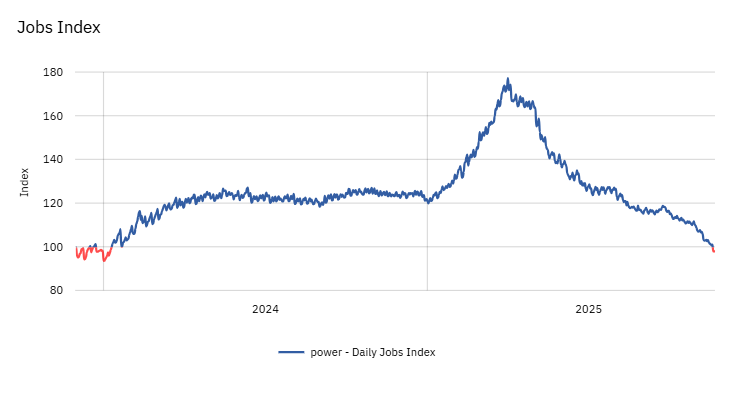
Vyakaranam explains that job dynamics were influenced by policy changes, construction seasons, and weather conditions. Recruitment became more focused, with an emphasis on specialized skills, particularly in tariff-related areas.
The outlook for 2026 suggests a continued focus on specialized expertise in areas such as grid planning, storage, and digital infrastructure.
Original Story at www.power-technology.com