Rivian’s Autonomous Ambitions: Navigating the Path to Innovation and Profitability
Rivian is navigating an intriguing phase in its journey towards innovation and profitability, focusing on autonomous vehicle technology amidst the rising competition in the EV market. During a recent earnings call, CEO RJ Scaringe highlighted the company’s aspirations for self-driving technology, while the spotlight shifted away from the production scale of the R2 SUV.
The coming years are pivotal for Rivian as it plans to debut its point-to-point hands-free driving feature, initially with its employees for testing in 2026, followed by a customer rollout in 2027. In collaboration with Uber, the company anticipates launching its first robotaxi fleet by 2028, a crucial step in Rivian’s strategy to become a leader in autonomous technology.
“We believe autonomy is a primary product differentiator, market share driver, and long-term value creator,” stated Derek Mulvey, Rivian’s VP for finance, during the call. The company faces a formidable challenge as it seeks to rival Tesla’s established presence in the autonomous vehicle sector, which has over 1.7 million active customers using its Full Self-Driving technology.
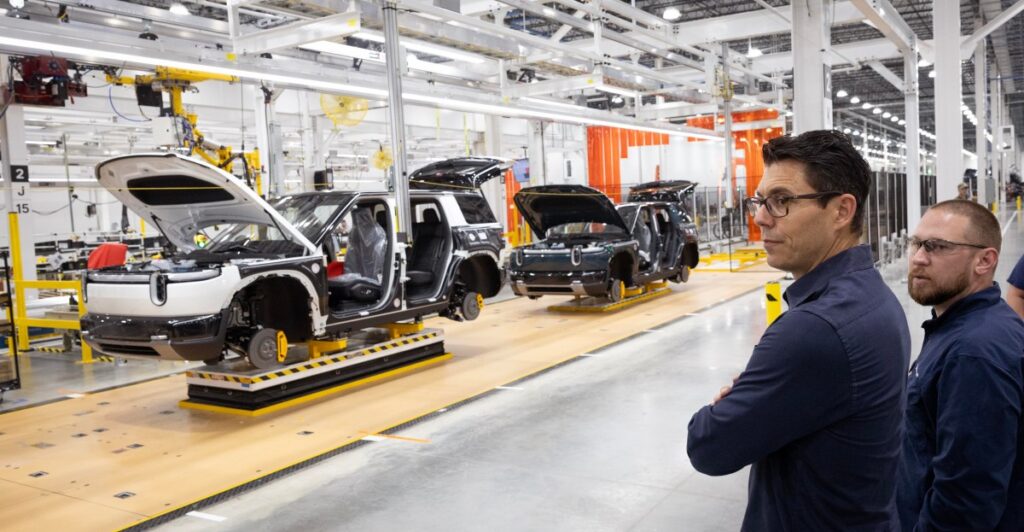
Rivian’s journey is financially demanding as it invests in designing proprietary silicon chips, procuring advanced sensors, and equipping itself with substantial AI computing power. This occurs even as the company endeavors to mass-produce its R2 vehicles, which have recently become its best-seller.
The company is balancing its focus between the R2’s market success and its autonomous vehicle development. CEO Scaringe shared his personal experience with the point-to-point driving system, describing it as “a wonderful experience” during his daily commute to the office.
However, details about the adoption of Rivian’s Autonomy Plus package remain under wraps, with Scaringe noting that subscription uptake has exceeded expectations, though specifics were not disclosed. Comparatively, over 75 percent of new Tesla buyers in North America have opted for Full Self-Driving in a recent quarter.
Financially, Rivian reported $605 million in revenue from software and subscription services in Q3 2026, marking a 45 percent increase year over year. The company achieved $256 million in profit from these services, representing a 42 percent profit margin.
Despite these successes, Rivian anticipates financial challenges due to escalating costs for computer chips and sensors, which may impact profits from the mass production of the R2. The company also confronts potential risks associated with its autonomous technology, such as legal challenges and brand reputation impacts if incidents occur.
Rivian’s strategic focus on autonomy aims to position it competitively against Tesla and Waymo. However, the significant investments required to scale both its autonomous technologies and the R2 vehicle make this a potentially risky period for the company.
Original Story at www.theverge.com