CALERA, Ala.—Fenn Church was resolute. “I’m going to stand in front of that gate and say, ‘This is my home, and I’m not letting you drive through that gate,’” Church stated. “If they want to arrest me, they can handcuff me and take me to jail or run me over. But this is where I take my stand.”
For months, Church contested Alabama Power’s use of eminent domain to access his property, arguing in Alabama’s lower courts that the utility had alternate routes for a transmission line less disruptive to rural Shelby County homeowners, 45 minutes south of Birmingham.
In September, his legal challenge resulted in a temporary injunction by Circuit Court Judge Jonathan Spann, preventing Alabama Power from accessing Church’s land. Spann ruled that Alabama Power had not adhered to state procedures for land condemnation, making Church likely to succeed on the case’s merits.
Testimony from an Alabama Power employee revealed that the planned transmission line’s route across Church’s property was decided without regard to zoning plans or the land’s development suitability, making Church’s claim likely to prove that the siting was arbitrary.
However, the victory was short-lived. On Wednesday, the Alabama Supreme Court, in a 5-1 decision, stayed Spann’s injunction, allowing Alabama Power to progress with their work. The court did not disclose reasons for its decision.
Alabama Power emphasized its commitment to fair dealings with property owners, stating the court’s decision advances a project crucial for electric grid security and reliability.
Faced with this setback, Church reached out to federal lawmakers—U.S. Sens. Katie Britt and Tommy Tuberville, and U.S. Rep. Barry Moore—but received no response before the work was set to begin.
Country music star John Rich, a Trump-appointed Special Envoy for American Homeowners, initially supported Church, advocating for respectful treatment of landowners. Yet, Church felt Rich faced resistance from the administration.
“Trump must’ve been told to back down,” Church speculated.
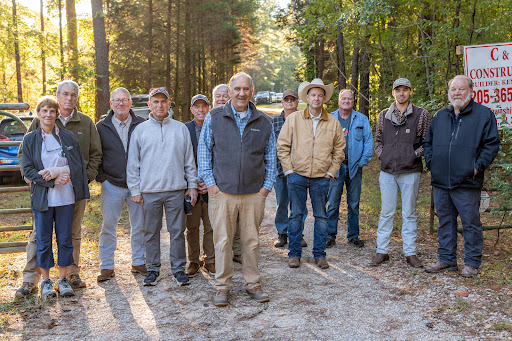
Hours after the Supreme Court ruling, Alabama Power informed Church’s lawyers of their intent to commence work between 7 and 8 a.m. Church turned to social media, urging supporters to gather at his gate.
“Tree cutting crews are coming to my front gate in the morning,” he posted, seeking support.
The post quickly gained traction, viewed over 100,000 times, attracting comments nationwide.
Rep. Phillip Ensler, a Democratic lieutenant governor hopeful, stood alongside Church, previously visiting in solidarity as the sole public official to do so.
“Alabama Power thinks it can just walk over anyone,” Ensler remarked. “They’re trying to intimidate, and if they succeed here, they can do it anywhere.”
As the morning warmed, Church and Ensler greeted supporters arriving in cars and trucks. One by one, they were welcomed with smiles, assurances of support, and Hardee’s biscuits.
The Alabama Power trucks did not arrive. Instead, around 8 a.m., a drone appeared overhead, surveying from above before departing.
Later, cameras recorded crews marking trees on the southern side of Church’s property, accessed from a different route.
“It was sneaky,” Church commented. “They knew we were here, so they went around back. It’s a dirty way of doing business.”
Alabama Power did not respond to requests for comment.
Around 11:30 a.m., Church received a call from Sen. Tuberville, who pledged to intervene with Alabama Power, a gesture Church appreciated, knowing Tuberville’s own family history with eminent domain.
Church, bracing for future challenges from Alabama Power, remains determined to protect his land. “If they try coming onto my property again, I’ll get everyone back up here,” he asserted. “We’ve got no choice.”
Original Story at insideclimatenews.org