China’s Car Market Sees Electric Surge Amid Declining Combustion Sales
In a historic shift, new-energy vehicles (NEVs) constituted 67% of new car sales in China during September, as per the latest figures from the China Passenger Car Association (CPCA). This significant market share comes despite a decline in overall NEV sales compared to the previous year.
The increase in NEV market share is attributed to a sharp decline in the sales of combustion-engine cars, a trend accelerated by rising petrol prices following the Hormuz crisis. The CPCA reported a 31% year-on-year drop in fuel-only car sales for the first nine months of 2026, while battery electric vehicle (BEV) sales saw a smaller decrease of 4%.
China’s expanding electric vehicle (EV) fleet has significantly reduced oil demand, saving an estimated 143 million barrels of oil since the onset of the Hormuz crisis, according to an analyst. Another expert highlighted that the crisis is “reinforcing China’s electrification of road transport.”
NEV Record
In September, data from the CPCA revealed that two out of every three cars sold were NEVs. This marked a substantial increase from a mere 6% share in 2020 to 58% in 2026 and 67% in September alone.
This rise occurred amidst a broader slowdown in the domestic passenger-car market, which hit combustion-engine vehicles particularly hard. September saw a 43% year-on-year drop in combustion-engine vehicle sales, while plug-in hybrid electric vehicle (PHEV) sales also fell by 36%.
Impact of Hormuz
NEVs’ advancement in 2026 has been partly due to the shifting market dynamics where petrol cars are losing ground. Higher petrol prices were cited by Cui Dongshu, secretary-general of the CPCA, as a key reason for the decline in combustion-car sales, as noted by the National Business Daily.
China’s oil imports dropped by 15% in the first nine months of the year compared to 2025, a decrease linked to the ongoing conflict impacting supply and prices. The shift towards NEVs has been underscored by the displacement of 143 million barrels of oil, as reported by Euan Graham, a senior energy analyst at Ember.
NEV Demand Down
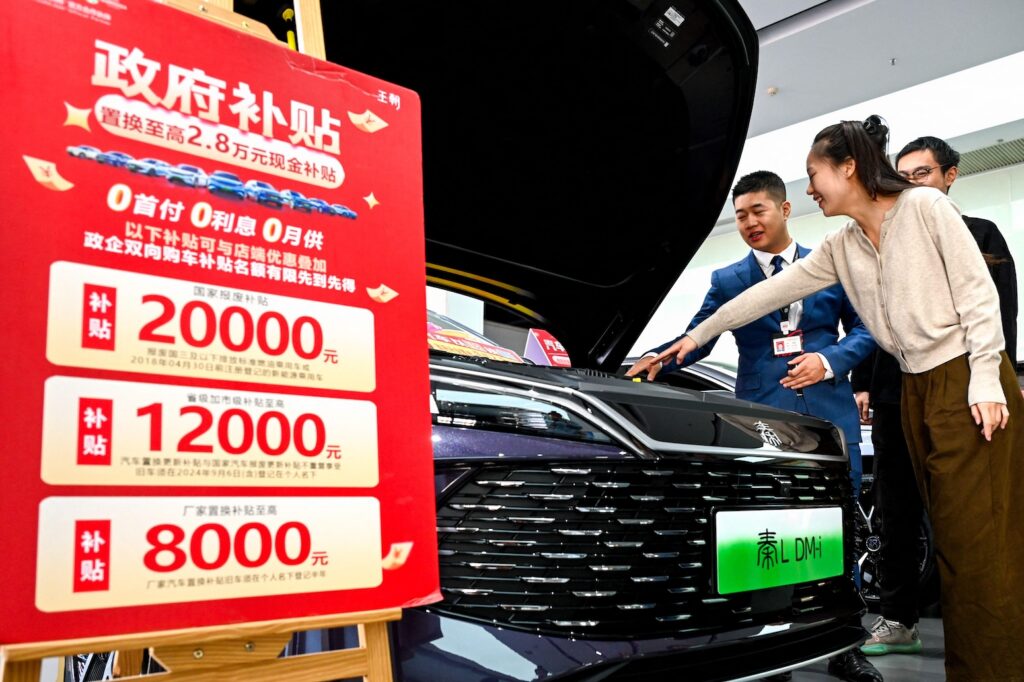
Despite the increase in market share, NEV sales have decreased year-on-year, though at a slower pace than overall car sales. Zhang Yichao, a partner at AlixPartners, attributed the resilience of NEV sales to government policies and a robust lineup of new models. However, he anticipates limited further growth potential for NEVs’ market share in China.
Exports Surge
Amid declining domestic sales, Chinese NEV exports have soared, more than doubling with a 164% year-on-year increase in September, according to the CPCA. This trend reflects a broader shift towards prioritizing exports as domestic demand weakens.
However, this surge in exports has raised concerns outside China, with the European Union imposing tariffs on Chinese EV imports. Despite these challenges, exports remain a “core priority” for Chinese carmakers, even as domestic policies like reduced VAT export rebates potentially impact export dynamics.
Original Story at www.carbonbrief.org