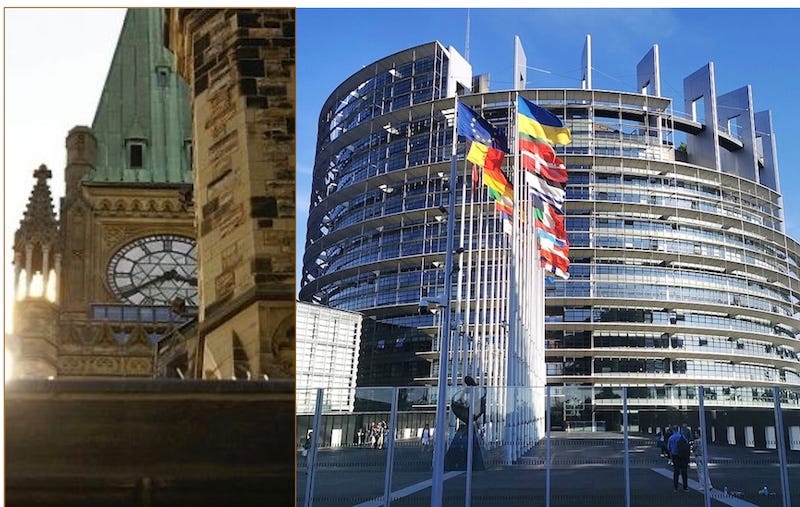
Canada and EU Summit: Ambitious Climate Promises Amidst Familiar Challenges
The Canada-European Union Summit in Montreal brought forth ambitious promises regarding climate change and energy transition. However, for many, it echoed past dialogues without substantial action. Rick Smith, President of the Canadian Climate Institute, emphasized the need to “turn talk into action” as the overarching sentiment.
While the summit primarily highlighted geopolitics and trade, climate change was a focal point. Despite strong language and commitments, there was concern that the outcomes might resemble previous pledges like the 2015 Paris Agreement and the 1.5°C imperative set by the IPCC in 2018. A lack of concrete action could render these promises merely rhetorical.
The summit recognized the “existential threat of the interdependent crises of climate change,” yet there were notable oversights, particularly regarding fossil fuel emissions. Discussions included plans to export Canadian liquefied natural gas (LNG) to Europe, contradicting emerging consensus suggesting Europe’s diminishing need for such resources.
During the summit, Canada’s EU Ambassador Jonathan Wilkinson hinted at recognition for Canada’s industrial carbon pricing. However, this suggestion faced criticism due to the comparatively lenient carbon pricing and its potential implications on the EU’s carbon border adjustment mechanism (CBAM).
Germany and France, EU climate policy leaders, face challenges from rising populism. Nonetheless, the Canadian Climate Institute remains cautiously optimistic. Their analysis of the summit’s seven-page joint statement highlighted a focus on integrating climate into the core of the agreement rather than treating it as an afterthought.
Prime Minister Mark Carney’s approach to the Canada-EU alliance is pivotal. His mantra of engaging with the world as it is rather than waiting for an ideal scenario will be crucial in translating promises into action. The Canadian Climate Institute, along with other observers, hopes this alliance will catalyze the necessary shifts towards a sustainable economy.
Eddy Pérez noted that out of 19 recent international partnerships, the Canada-EU deal uniquely prioritizes climate change and energy transition. This represents a significant opportunity to diversify Canada’s trade, reducing reliance on the United States and asserting sovereignty.
The European Investment Bank’s (EIB) commitment to investing in Canada’s critical minerals is a promising step. However, it will be crucial to ensure that investments respect Indigenous rights and environmental standards. The summit’s discussions on LNG exports and Canada’s lag in sustainable finance taxonomy also underscore the need for careful evaluation and evidence-based decisions.
Methane emissions remain a critical issue, with calls for stringent controls to achieve significant pollution reductions. As the EU and Canada continue their partnership, maintaining high standards for climate policies and ensuring adherence to global norms is essential.
Ultimately, while a closer partnership with the EU can drive more ambitious climate policies, Canada must proactively address its own challenges. As Pérez stated, “The fact that Canada is behind does not mean they’re not interested in strengthening some of those rules.” The partnership represents a collaborative effort to achieve long-term sustainability goals.
Original Story at energymixweekender.substack.com